
Accept Your Own Hell

The Divine Comedy could be read as an allegory of the soul’s adventure toward God or its higher self. Although this epic poem was written in the 13th century, its holistic messages are relevant and hold some solid truth about the fragility and strength of any humans.
The story starts with Dante finding himself in the realm of hell. He doesn’t arrive there on purpose. Nothing prior to this scene predicts his arrival at this undesirable place. His situation resembles the experience of a lot of humans. In my deepest belief, it is certain that the majority of humans do not intend to become evil, purposely commit sins, or strive toward negative outcomes. Due to a lack of consciousness, we go astray from the main courses of our lives, the courses that hold our truest values. The causes of this outcome could be numerous pride, distraction, greed, etc.
"Midway in our life's journey, I went astray from the straight road and woke to find myself alone in a dark wood..." _ Inferno, Canto I
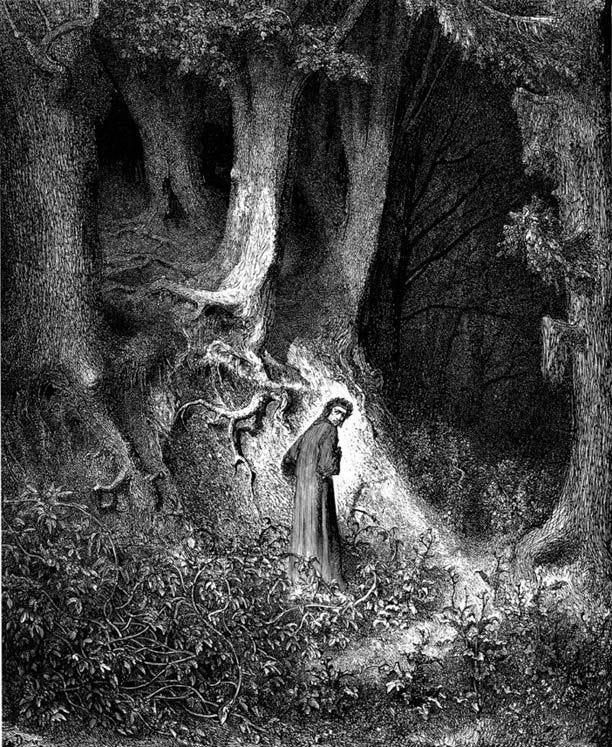
The character of Dante in Inferno is worth examining. Dante the Poet isn't afraid to show his inner struggles to give his audience both implicit and explicit hints of why he ends up at such a terrible place. At Limbo, Dante purposely counts himself amongst the great classical poets, Homer, Horace, Ovid, Lucan, and Virgil, his guide.
“And they honored me far beyond courtesy,
For they included me in their own number,
Making me sixth in that high company.”
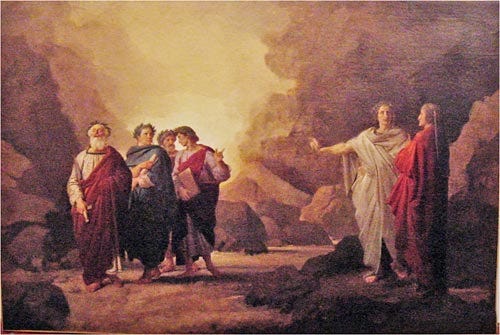
By putting himself alongside these poets, Dante reflects his unspoken pride. His pride is highlighted in the following scenes in which he portrays nightmarish stages of hell and severe punishments to rebuke his enemies and exact retribution against those who upset him or offend his religious and political beliefs. There are many instances in which Virgil scolds him for his lost of self-control to wrath when he meets his enemies.
“May you weep and wail to all eternity,
for I know you, hell-dog, filthy as you are”
Dante the Pilgrim acts from emotional impulses. He torments his enemies with words, abuses them, and expresses contentment watching their suffering. These illustrations reflect a lack of compassion in his character, which is part of his emotional state.
Yet, overall, as he keeps moving toward the destination of his adventure. These flaws do not interfere with his arrival at heaven but highlight his heroic conquest–his conquest of self. He has the willingness to accept his own flaws and face each flaw with grit. It requires a lot of courage from a human to closely re-exam the weakness in their personalities.
From Dante’s story, I hope we find the strength to admit our situation and our flaws, no matter how despicable. Because this is the first step to become our best selves. No matter where we realize we are at. With courage and a sincere desire to, all the obstacles, devils are only there to reveal the virtues that are buried deep in us.